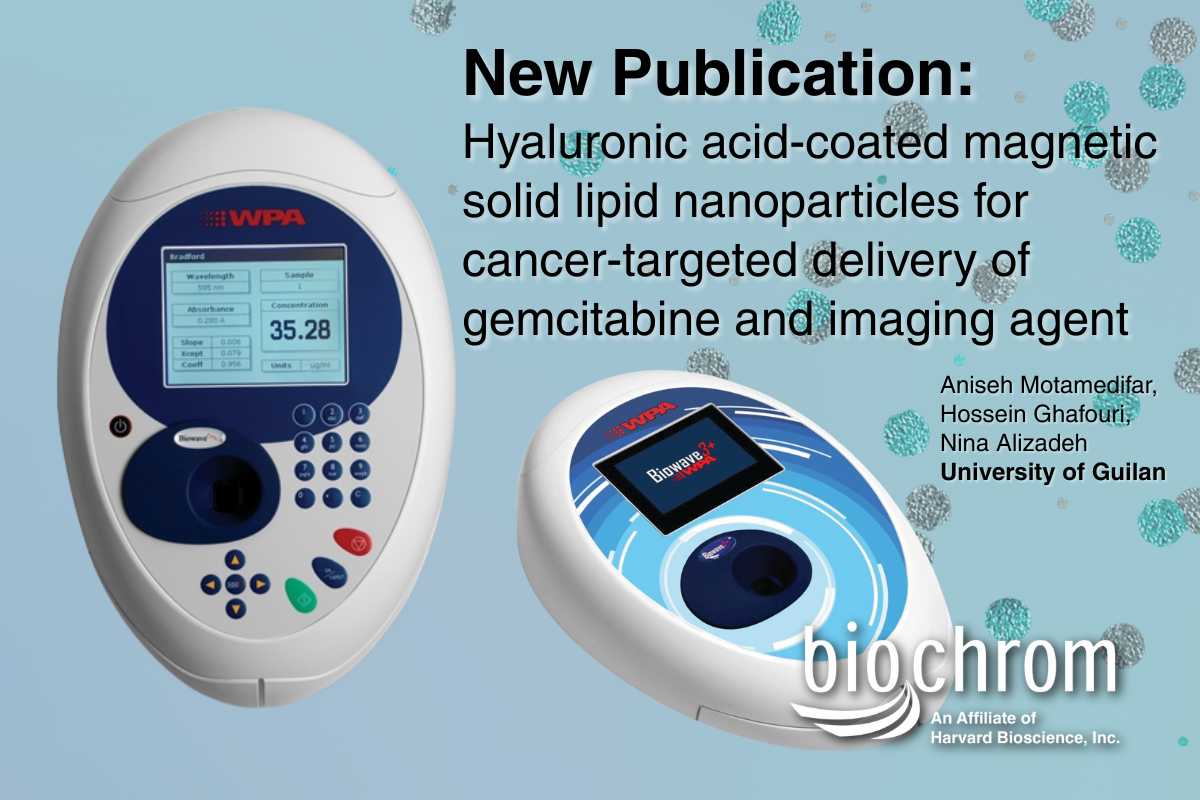
Hyaluronic Acid-Coated Magnetic Nanoparticles: A Platform for Targeted Gemcitabine Delivery
By measuring Gem absorbance at 269 nm, the Biowave enabled precise determination of unencapsulated drug and calculation of EE%. Such reproducible spectrophotometric data was critical in validating formulation design, ensuring nanoparticle stability, and correlating entrapment with downstream release kinetics.
The treatment of solid tumours with gemcitabine (Gem) has long been constrained by its pharmacokinetic limitations, including rapid enzymatic degradation, short plasma half-life, and dose-limiting systemic toxicities. To address these issues, a recent study reports on the design of hyaluronic acid-coated magnetic solid lipid nanoparticles (HA/Gem-Mag-SLNs), which integrate therapeutic and diagnostic (theranostic) functionalities into a single nanoplatform.
Key Advances in Nanoparticle Engineering
The nanoparticles were engineered by encapsulating gemcitabine alongside superparamagnetic iron oxide nanoparticles (SPIONs) within a lipid matrix, followed by surface modification with hyaluronic acid (HA). This configuration offers several important advantages:
- CD44-mediated Targeting: HA ligands promote selective uptake into tumour cells overexpressing CD44, enhancing drug accumulation at the tumour site.
- Enhanced Stability and Release Control: HA coating reversed the surface charge of Gem-Mag-SLNs, improved colloidal stability, and enabled a sustained release profile (only ~18% of Gem released after 72 h), reducing the burst effect observed with uncoated formulations
- Magnetic Responsiveness and Imaging: Encapsulated SPIONs retained superparamagnetic properties, allowing for potential magnetic field-guided targeting and contrast enhancement in MRI applications
- Reduced Cytotoxicity: In vitro assays with MDA-MB-231 cells demonstrated that HA/Gem-Mag-SLNs significantly lowered the IC50 value compared to both Gem-Mag-SLNs and free Gem, confirming superior antitumor activity
Collectively, these properties suggest that HA/Gem-Mag-SLNs can function as multifunctional drug delivery systems capable of improving therapeutic efficacy while simultaneously enabling tumour imaging and monitoring.
Analytical Validation with the Biowave
Quantitative evaluation of drug entrapment efficiency (EE%) was performed using the Biochrom WPA Biowave UV–Vis spectrophotometer. By measuring Gem absorbance at 269 nm, the Biowave enabled precise determination of unencapsulated drug and calculation of EE%. Such reproducible spectrophotometric data was critical in validating formulation design, ensuring nanoparticle stability, and correlating entrapment with downstream release kinetics.
Implications for Future Therapies
This study highlights the potential of HA/Gem-Mag-SLNs to advance cancer therapeutics through:
- Targeted chemotherapy with reduced systemic exposure,
- Theranostic integration, enabling drug delivery and imaging in one platform,
- Improved pharmacological profiles of established cytotoxics like gemcitabine.
The use of robust analytical tools such as the Biowave was central to confirming these findings, providing the quantitative rigor needed to translate nanoscale formulations into viable clinical candidates.
Next Steps Toward Translation
While the in vitro results are highly promising, several key stages are required before clinical application:
- In vivo pharmacokinetics and biodistribution: Animal models will be necessary to determine systemic circulation, tumour accumulation, and clearance pathways.
- Efficacy studies in xenograft models: Confirming tumour regression and survival benefits compared to free gemcitabine.
- Toxicology and safety assessments: Evaluating immunogenicity, off-target accumulation, and long-term retention of SPIONs.
- Scale-up and reproducibility: Ensuring consistent nanoparticle size, entrapment efficiency, and coating integrity under GMP-compatible conditions.
Only after these preclinical and translational studies can HA/Gem-Mag-SLNs move toward early-phase clinical trials. We look forward to hearing more about this work as it progresses
Learn more about the Biochrom WPA Biowave UV–Vis spectrophotometer.